
Eval Crusher feature
Liquidity Grabs: Why Price Sometimes Pokes Out and Snaps Back
November 4, 2026 · 3 min read · Hobe Sound Trading
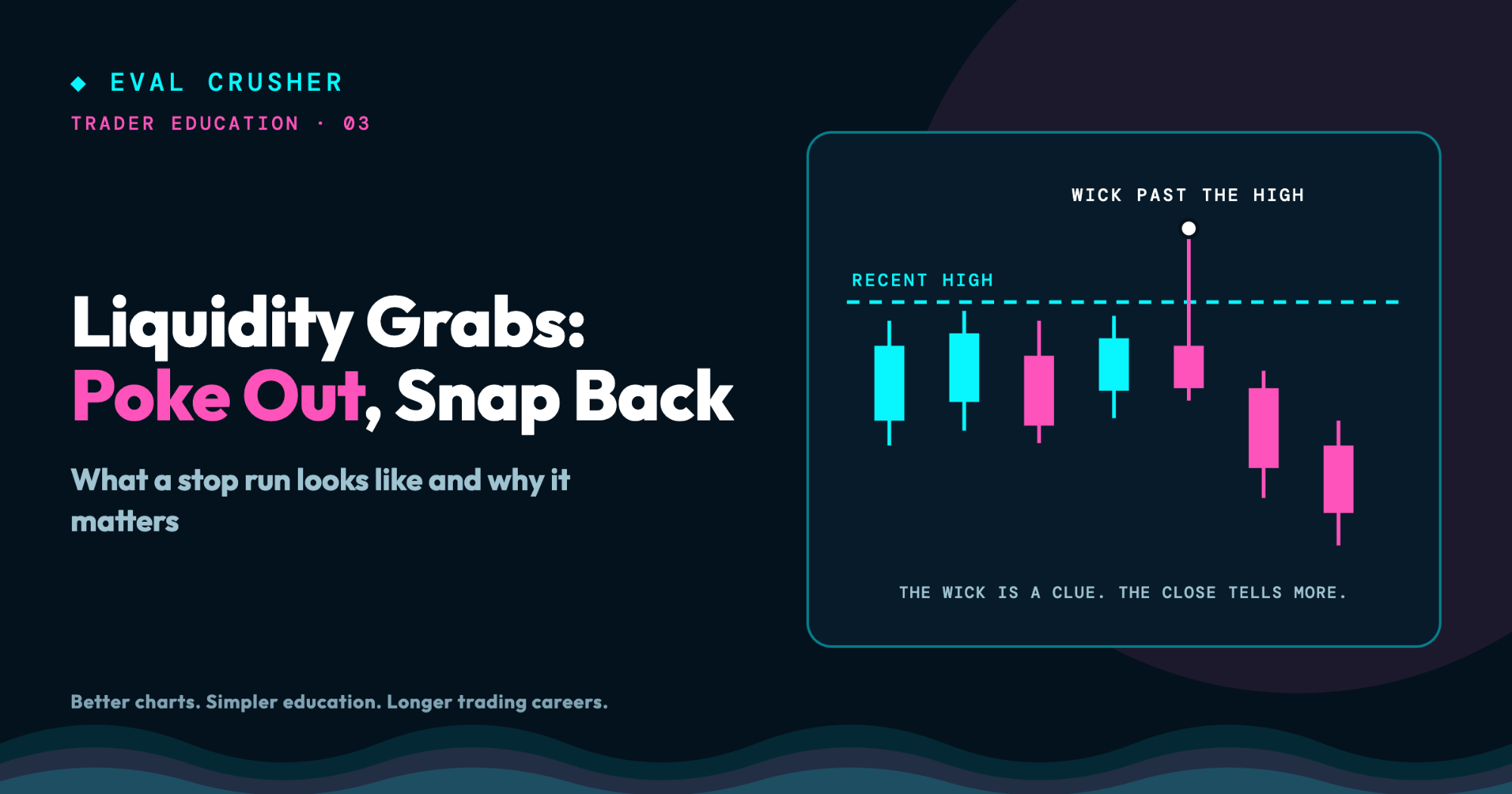
You set your stop just under the recent low. Price dips right through it, takes you out, and then turns around and runs the other way. It feels personal, but it’s a pattern with a name: a liquidity grab.
What’s going on
Obvious highs and lows attract orders. Traders put stops just above highs and just below lows, and breakout traders place entries in the same spots. Those clusters of orders are “liquidity.” Larger players need that liquidity to fill their own orders, so price sometimes pushes just past a level, triggers the orders sitting there, and then moves back the other way.
You’ll also hear it called a stop run or a sweep.
What it looks like
- Price pokes past a recent high or low.
- The candle leaves a long wick on that side.
- Price closes back inside, where it started.
It’s a quick move out and a quick move back, like a wave that reaches up the beach and slides away.
Why it matters
It keeps you from treating every poke past a level as a real breakout. It also explains a lot of stops that get hit by a few ticks before price goes the other way. Knowing the pattern exists won’t stop every stop-out, but it can change how you read what you’re seeing.
How traders think about it
- Wait for the close. A wick alone isn’t confirmation. Where the candle closes tells you far more.
- Location counts. A sweep at an important level, like the edge of the daily range, carries more weight than one in the middle of nowhere.
- Not every poke is a grab. Sometimes price breaks a level and keeps going. That’s why context matters.
Letting the indicator point it out
When price sweeps a recent high or low and closes back inside, the coach drops a small note on the chart so you can see it happen in real time and learn to recognize it.
The takeaway
A wick is a clue, not a conclusion. Slow down, watch the close, and ask where it happened.
Educational content only, not financial advice. Futures trading involves substantial risk of loss and isn’t suitable for everyone.
See it on your own chart.
Eval Crusher puts the range, the market read and plain-English coach notes right on your TradingView chart.
EXPLORE EVAL CRUSHER